

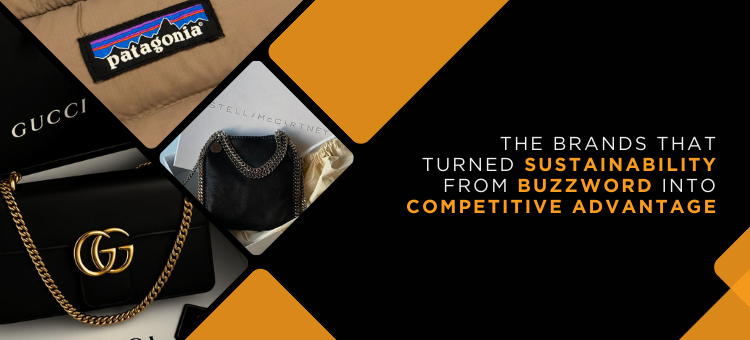
Sustainability stopped being optional around 2023. For luxury brands, it became a survival strategy, and for the smartest ones, a genuine competitive edge. Whilst many houses issued glossy ESG reports that gathered digital dust, a select few embedded sustainable practices so deeply into operations that they gained market share, customer loyalty, and cultural credibility. These brands didn’t just “go green”; they made it their signature move.
Stella McCartney: Sustainability as DNA
Stella McCartney never waited for the industry to catch up. From her earliest collections, she banned leather, fur, and exotic skins, choices that raised eyebrows in 2001 but now look prophetic. By 2025, her commitment to innovation over imitation makes her the gold standard for conscious luxury.
What distinguishes her approach isn’t moral posturing but tangible results. Her Mylo™ mushroom leather and lab-grown diamonds aren’t novelties; they’re commercially viable alternatives matching (sometimes exceeding) traditional materials in quality and aesthetic appeal. Partnerships with Bolt Threads and regenerative cotton pioneers turned experimental materials into red-carpet staples.
The business wins? Younger consumers who might have dismissed luxury altogether now see Stella as both aspirational and ethically sound. Her brand equity grew 18% year-on-year in 2024, even as the broader sector contracted. Sustainability didn’t dilute her premium position; it sharpened it.
Gucci: From Backlash to Blueprint
Gucci’s journey proved messier. A 2019 sustainability backlash forced the brand beyond PR platitudes. By 2025, Gucci achieved carbon neutrality across operations and launched Equilibrium, a roadmap blending creativity with environmental responsibility.
Key accomplishments included 100% renewable energy across all ateliers, stores, and offices; recycled carbon alcohol for perfumes through Coty partnership; dematerialisation of packaging, cutting waste by 30%; and traceability for 95% of raw materials.
Gucci didn’t just report numbers; they made sustainability photogenic. The “Gucci Off The Grid” collection used entirely recycled or bio-based materials and sold out within hours. Social media transformed green credentials into glamour, proving conscious consumers crave beauty alongside ethics, not sacrifice.
Sales data validates this approach. Gucci’s sustainable lines outperformed core collections by 22% in key markets, whilst their resale value held 15% higher than competitors. Kering’s broader ESG strategy amplified this effect, and Gucci became the demonstration case proving that profit and planet can genuinely align.
Patagonia: Premium Through Permanence
Patagonia operates outside traditional fashion luxury but shares an identical strategic playbook: manufacture products so exceptional that customers never need replacement. Their “Don’t Buy This Jacket” campaign (2011) seemed radical; by 2025, it represents conventional wisdom.
What luxury brands overlook, Patagonia mastered comprehensively. Their Worn Wear programme enables customers to trade used gear for credit, creating a circular ecosystem. Fair Trade Certified factories produce 85% of output, paying living wages. Regenerative organic agriculture positions soil health as an actual selling point.
The genius lies in the pricing strategy. Patagonia charges premium rates because products last three to five times longer than fast fashion equivalents, dramatically increasing lifetime customer value. Luxury houses, including The Row and Loro Pian, have quietly adopted similar “investment piece” narratives around exceptional durability.
Patagonia’s resale market thrives independently, and vintage fleece sells at 120% of the original retail price. They transformed sustainability into a self-reinforcing cycle: satisfied customers, reduced churn, stronger secondary market, enhanced reputation.
LVMH: Scale as Sustainability Strategy
LVMH didn’t invent sustainable luxury, but they industrialised it. LIFE 360 integrates environmental objectives across 75 maisons, from Louis Vuitton to Dior to Sephora. By 2025, achievements include 55% reduction in Scope 1 and 2 emissions (SBTi-validated), 78% responsibly sourced raw materials, and 97% renewable energy globally.
Louis Vuitton’s leather carries 96% LWG certification; Dior’s supply chain operates on blockchain traceability. Smaller brands benefit from LVMH’s research and development, shared mycelium leathers and bio-fabrics, lowering entry barriers for niche houses.
The conglomerate effect proves powerful. Smaller players gain credibility through association; LVMH gains scale efficiencies. Their stock outperformed luxury sector peers by 12% in 2024, partly because investors recognise sustainability as risk mitigation rather than a cost centre.
Indian Innovation: Anita Dongre and Beyond
India’s luxury landscape produces distinctive leaders. Anita Dongre blends artisanal craft with ARISE, her sustainability manifesto promising zero-waste silk weaving, grassroot collectives supporting 25,000+ rural artisans, and upcycled bridal collections.
Good Earth utilises reclaimed woods and fair-trade gemstones; Nicobar sources organic cotton from Gujarat farmers. These brands don’t merely discuss sustainability, they embody it through centuries-old techniques modernised for global markets.
Dongre’s international recognition (Met Gala, Neiman Marcus) demonstrates local innovation competing globally. Her collections maintain 40% higher margins than non-sustainable peers despite equivalent price points, proving responsible practices need not compromise profitability.
Indian Purity: Nurabare and the New Skincare Conscience
India’s skincare landscape is producing a new kind of leader. Nurabare blends ancient botanical wisdom with modern clean formulation, building a brand that promises zero-compromise ingredients, transparent sourcing rooted in Ayurvedic tradition, and skincare rituals designed for real skin rather than filtered photographs.
Integration Over Theatre
What separates leaders from laggards? Complete integration. Sustainability isn’t a side project or annual report exercise; it permeates every decision. Successful brands embed environmental considerations from initial design sketches, partner strategically with genuine innovators rather than PR agencies, measure commercial impact, including resale value and customer lifetime value, and,d crucially, make sustainable products beautiful.
Market performance validates this approach. Sustainable luxury lines grow 25-30% faster than traditional collections across categories. Younger consumers (under 35) represent 68% of new luxury spending, and 82% prioritise sustainability credentials when selecting brands.
The Strategic Reality
Sustainability isn’t corporate charity, it’s sophisticated capitalism. Leading brands prove environmental practices create competitive moats: higher margins, stronger customer loyalty, premium pricing power, and immunity from regulatory disruption. They’ve transformed existential threat into existential advantage.
For brands still treating sustainability as a marketing buzzword, the competitive gap widens daily. The future belongs to those making environmental responsibility commercially irresistible.
At LCBS, we examine how sustainability transforms from a cost centre to a competitive advantage, teaching the strategic frameworks luxury brands use to build genuine environmental credentials whilst strengthening market position.